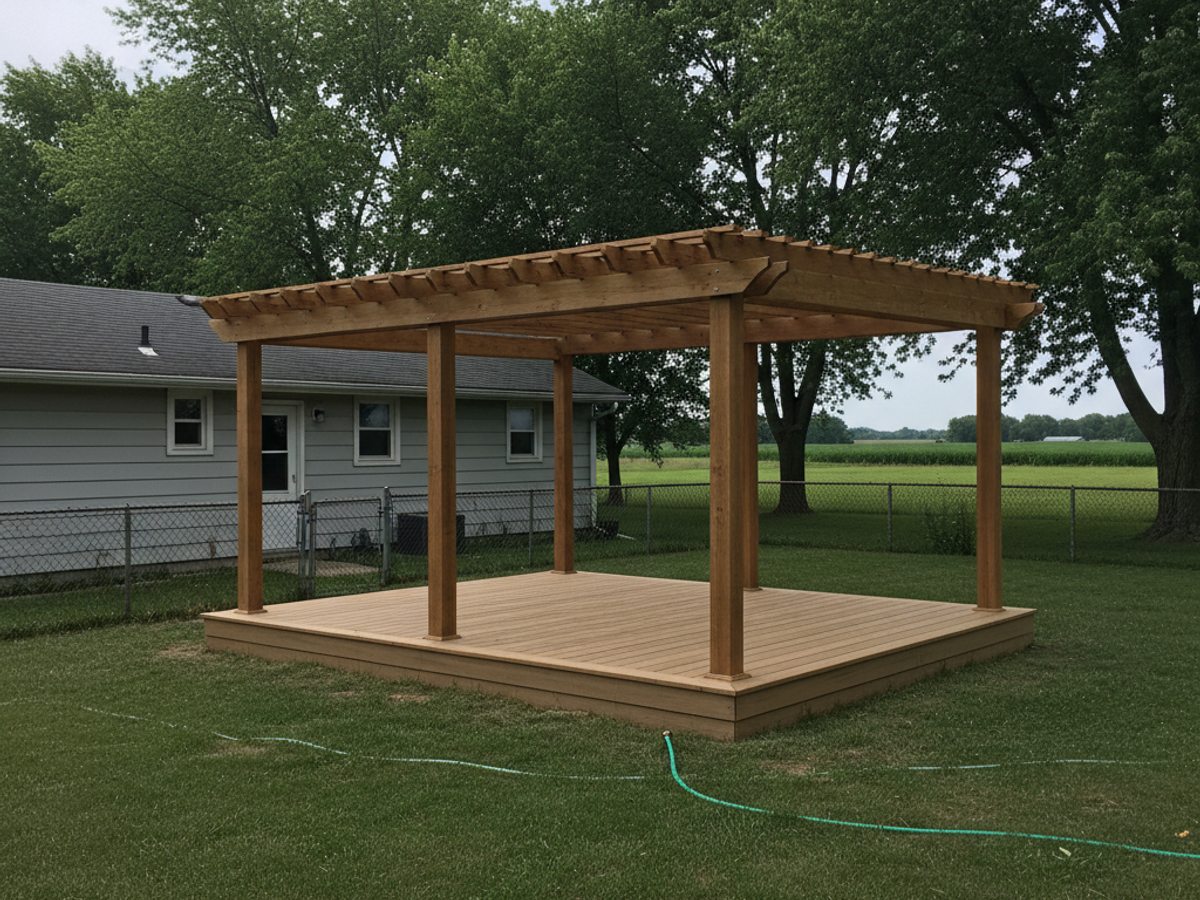
Every deck bid you get is going to look the same on paper. Square footage, decking material, railing style, a number at the bottom. The differences that actually matter are underground and at the ledger board, and most homeowners never think to ask about either until something's wrong.
Milwaukee has a specific set of conditions that make deck work here different from a deck in Phoenix or Atlanta. Southeastern Wisconsin sits on heavy clay soil that holds water and heaves when it freezes. Our frost line runs 42 to 48 inches deep depending on where you are in the county, and the Wisconsin Uniform Dwelling Code requires footings to bear below that line. A footing poured at 24 inches might hold the deck up for two winters. By year three, frost heave has pushed a corner post up half an inch and your railing's out of square. That's not a workmanship problem you can see when you shake hands on a bid. It's a number you have to ask for.
Ask how deep the footings go, and get it in writing
Any builder who knows what they're doing will tell you the footing depth without hesitating, and it should be at or below 48 inches in this area regardless of what the deck weighs. If someone quotes a shallower depth to save you money on concrete, that's not a discount. That's a deck that'll need to be pulled apart in five years. Ask them to put the depth in the contract, not just say it out loud.
Ask how the ledger attaches to your house
The ledger board is the piece bolted to your house that half the deck hangs off of, and it fails more often than any footing does. On homes built in Bay View, Washington Heights, or Riverwest before the 1950s, you're often dealing with balloon framing, older rim joists, or brick veneer, and none of those take a ledger attachment the same way a 2010 build in Franklin or Oak Creek does. A ledger lagged into brick veneer with no structural connection behind it is one of the most common failures we see on older Milwaukee decks, and it's usually invisible until the deck starts to pull away from the house during a heavy snow load. A builder should be able to explain, specifically, what's behind your siding and how they're bolting into it, whether that's through-bolts into rim joist, flashing tape under the ledger to keep water from wicking into the band board, or a decision that your house needs a freestanding deck instead because the existing structure won't take a ledger safely at all. If they can't answer that question about your specific house, they haven't looked closely enough to be building on it.
Find out who's pulling the permit
Most deck projects in the City of Milwaukee and surrounding municipalities need a building permit, and it's usually required once the deck is attached to the house or exceeds a certain height off grade, though the exact threshold varies by municipality. The City of Milwaukee's Department of Neighborhood Services handles permitting and inspection inside city limits; suburbs like Wauwatosa, West Allis, Greenfield, and the towns further out each run their own permitting through their own building departments. A legitimate builder pulls the permit themselves, in their name, and schedules the footing inspection before backfilling and a final inspection once the deck's framed and railed. If a contractor tells you permits are a waste of time or that they'll "just build it and we won't say anything," walk away. An unpermitted deck can hold up your home sale later when the buyer's inspector flags it, and it can leave you with zero recourse if the structure fails, because there's no inspection record showing it was ever built to code. It also matters for setbacks. Lots in newer subdivisions often carry HOA rules on deck size, materials, and even stain color, so it's worth checking your covenants before you fall in love with a design. Older city lots usually don't have an HOA to deal with, but they do have zoning setback lines from the property edge that a surveyor or the permit office can confirm.
Red flags worth walking away from
- A bid that's dramatically lower than every other one you got. Lumber, footings, and hardware cost roughly the same no matter who's buying them. A number that's way out of line usually means something's getting skipped, and it's usually the part you can't see once the boards are down.
- No written contract, or a contract that doesn't list footing depth, joist spacing, decking brand, and railing spec by name.
- Asking for full payment up front. A deposit is normal. The full amount before a single footing is dug is not.
- No proof of insurance. If a worker falls off a ladder on your property and the contractor's uninsured, that liability can land on you.
- Vague answers about how they're handling an existing deck that's coming out. Demo, disposal, and what happens to the old footings should be spelled out, not waved off.
Get quotes that are actually comparing the same thing
Pressure-treated pine and composite decking aren't interchangeable in a bid, and neither are 12-inch on-center joists versus 16-inch. Composite decking needs tighter joist spacing in some cases depending on the manufacturer's span rating, and it needs gapping left between boards for thermal expansion, because Wisconsin swings from -10°F in January to 90°F in July and composite moves more than wood does across that range. If one quote spec's 16-inch joist spacing and another spec's 12-inch under the same composite brand, they are not the same deck, even if the square footage on the page matches. Ask each bidder to write down the joist spacing, the fastener type, and the decking brand and line, then compare those instead of just the bottom line number.
A deck in this city has to survive freeze-thaw cycling roughly five to six months a year, plenty of rain in spring and early summer, and full sun exposure through the summer that can fade a stain job faster than people expect. None of that is exotic. It's just specific, and a builder who knows the ground here will talk about it without being asked twice. If you want a second set of eyes on a bid you already have, or you're starting from scratch, Sunrise Deck Co works throughout Milwaukee and the surrounding towns and is happy to walk you through what should be in it.