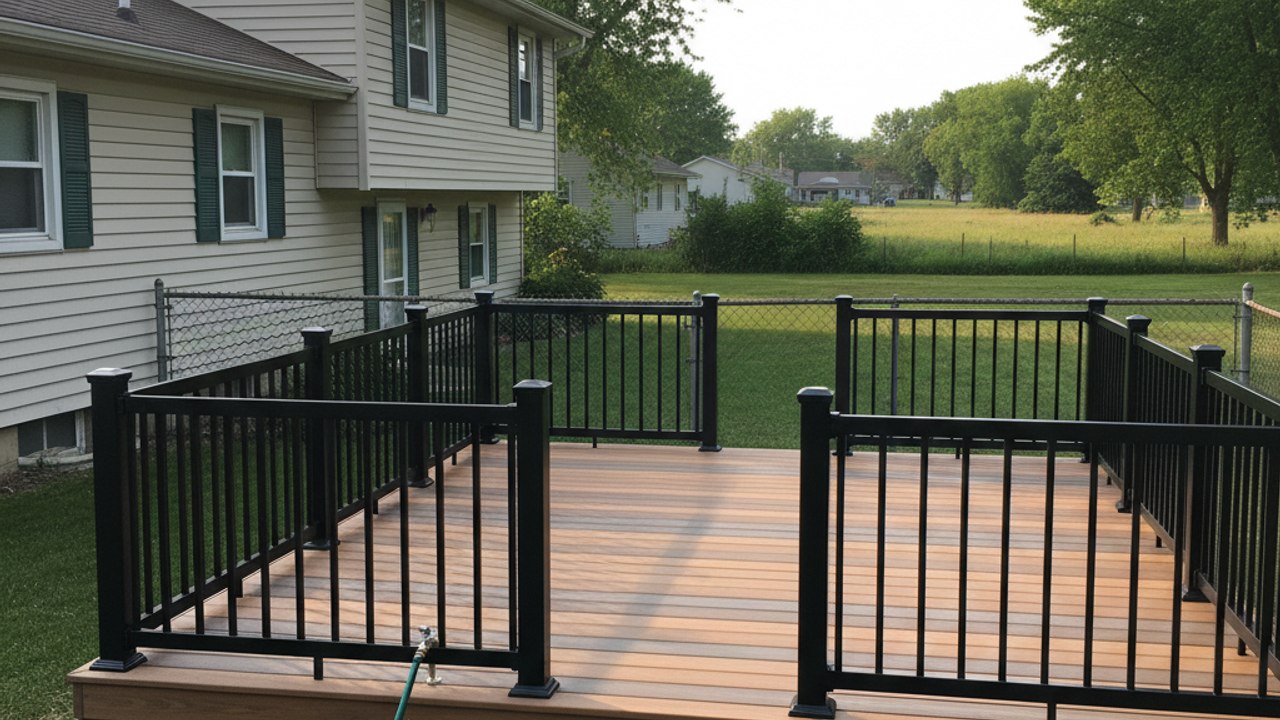
Every deck in Milwaukee is held up by whatever is 42 inches down, whether the homeowner ever thinks about it or not. That number isn't a guess. It's the frost depth this part of Wisconsin builds to, and it's the reason a deck footing here looks nothing like one in Georgia or Arizona. Get the footing wrong and the deck won't fall over. It'll just slowly tilt, crack, or pull away from the house, usually over two or three winters, by which point nobody remembers the install.
Why we dig as deep as we do
Water in the soil freezes and expands. In a Milwaukee winter that freeze line pushes down about 42 inches in a bad year, sometimes a little less under snow cover, sometimes more in an exposed yard with no insulation on top. If a footing sits above that depth, the ground underneath it heaves every time it freezes and settles back unevenly every time it thaws. Do that for a few winters and you get a deck post that's noticeably higher than the one next to it, a ledger board pulling at its lag bolts, railing that used to be plumb and isn't anymore. We set footings below 42 inches and we don't shortcut that number because a yard looks firm in August. August tells you nothing about January.
Sonotubes vs. helical piers
Most decks here still go on concrete-filled sonotube footings, poured into an augered hole with a bell shape at the bottom for bearing. That works fine once you're past the clay layer and into firmer soil. On a few lots, usually ones with a lot of fill dirt or a high water table, we'll use helical piers instead. Those are screwed down mechanically to a set torque, which tells you exactly what they're bearing on instead of hoping a hand-dug hole hit good soil. They cost more per point but they solve problems a sonotube can't, especially on a wet backyard that never fully dries out.
The clay itself is the other half of the problem
Most of the Milwaukee area sits on glacial clay till, laid down by the last ice age and about as cooperative as it sounds. Dry clay is hard as brick and a pain to auger through. Wet clay swells, holds water like a sponge, and barely drains at all. That matters for two reasons. First, if a footing hole sits full of standing water after a rain, you don't pour concrete into it and hope. You pump it out or you wait. Second, clay that swells unevenly around a footing can actually grip the concrete and drag it upward during a freeze, a problem called frost jacking, which is a separate failure mode from simple heave and one more reason the footing needs to go deep enough and wide enough at the base to resist it.
Sandier pockets do exist, mostly near the lake and in a few of the outlying towns, and when we hit one it genuinely makes the dig easier. But you don't know what's under a given yard until the auger tells you, which is one reason a flat phone quote for footing work isn't something we hand out before digging starts.
Where the water goes once the deck is up
A lot of Milwaukee lots were graded decades ago and haven't been touched since, which means the slope away from the house isn't always what it should be. Add a deck and you've added a roof over part of that ground, which changes how water moves underneath it. We grade and set footings so runoff still has somewhere to go, usually away from the foundation and toward whatever drainage path the lot already has. On lots where water already pools against the house, which isn't rare in the older neighborhoods with flatter yards, we'll flag it before building rather than build a deck over a standing-water problem and let the homeowner find out in April.
Older streets vs. newer subdivisions
A deck job on a street in Bay View or Washington Heights, built in the first half of the last century, usually means digging near an older clay sewer lateral, maybe an abandoned cistern, sometimes fill dirt nobody documented. A job in Franklin, Oak Creek, or one of the newer Waukesha County subdivisions usually means more consistent compacted fill, laid down to spec when the lot was developed, which generally digs cleaner and more predictably. Neither is harder in principle. They're just different, and it changes what we expect to find before the auger ever goes in the ground.
Either way, we call Diggers Hotline before any digging starts. It's free, it's required, and it's the only way to know where the gas, electric, and any private lines actually run before a footing hole goes anywhere near them.
Permits and inspections
Milwaukee and the surrounding municipalities each run their own permitting through their local building department, and most require a permit for anything structural, which covers new decks, major repairs, and most multi-level builds. The inspector typically wants to see the footings before concrete goes in, checking depth and diameter against the frost line, then comes back for a framing inspection before decking boards go down. Skipping that first inspection and pouring anyway is the kind of shortcut that shows up later, usually when the house gets sold and a buyer's inspector asks for documentation that doesn't exist. Some neighborhoods also have HOA rules on deck height, railing style, or setback from the property line, which is worth checking before design starts rather than after the footings are in.
None of this is complicated once someone's actually done it on a Milwaukee lot a few times. It's mostly a matter of not treating the ground as an afterthought. We've dug enough footings in this clay to know where it's going to fight us and where it isn't. If you're planning a new deck, a rebuild, or just wondering why your current one has started to lean, Sunrise Deck Co can take a look at what's actually under it before anything gets built on top.